
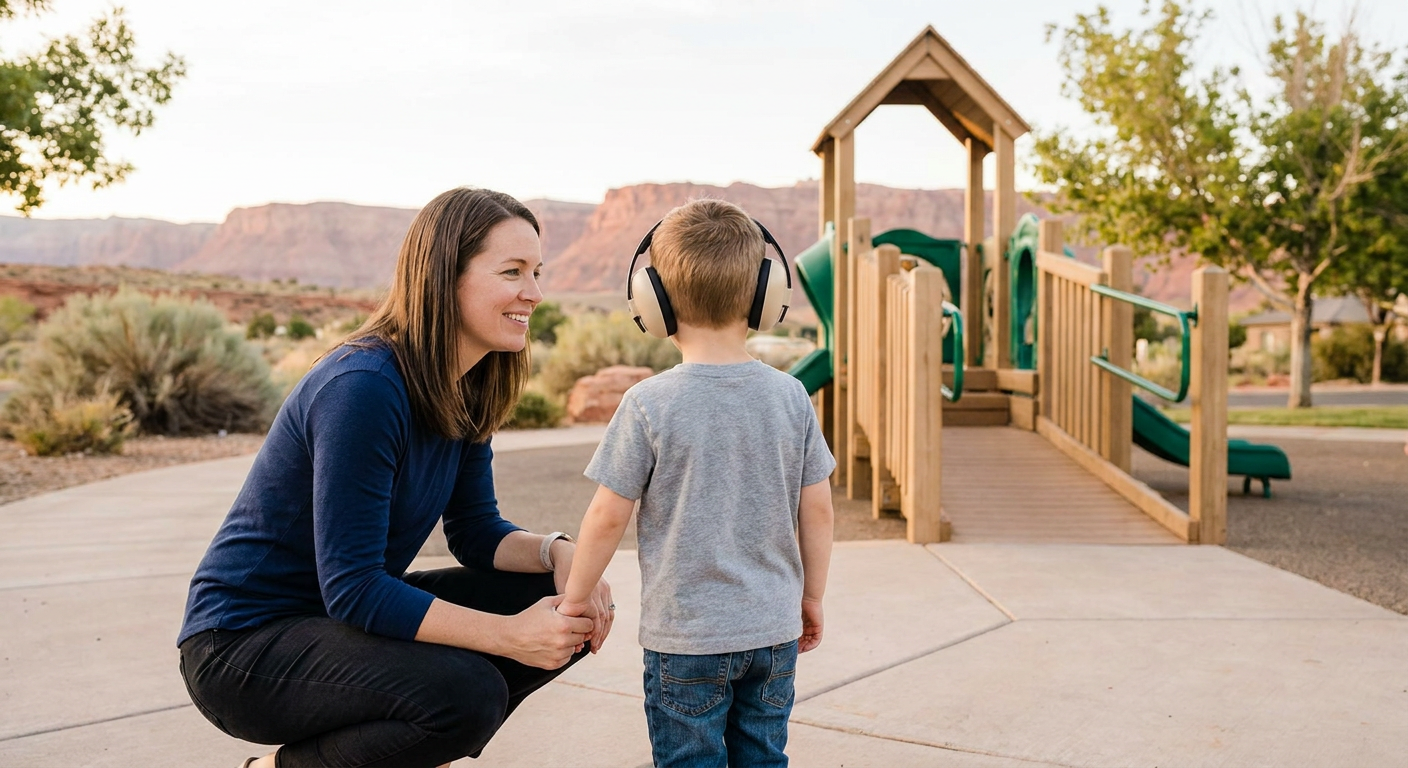
If you are searching for sensory friendly St. George options, the real question is usually not just what is available. It is whether your family can choose an outing that feels manageable today.
For many parents, that decision comes up on a weekend, during a school break, when relatives are visiting, or when a backup plan is needed because energy and regulation feel less predictable than usual. This guide is designed to help you choose a St. George outing that fits your child’s sensory profile, current capacity, sibling needs, and your family’s margin for unpredictability.
This is not a general autism explainer or a tourism roundup. It is a practical, local planning guide built around real-life sensory fit. If you want a better sense of the local team supporting families in Southern Utah, you can also meet the St. George team.
What Makes an Outing Sensory-Friendly in St. George?
A sensory-friendly outing is not just a place that says it is inclusive. It is a place that feels workable for your child on that specific day.
Before leaving home, most families need to think about a few basic questions: How predictable is the environment? How much noise, bright light, crowding, waiting, or transition load should you expect? Is there space to move, take a break, or step away? Are bathrooms, shade, seating, and parking easy to access? Can siblings with different needs realistically enjoy the outing too?
That is why a venue can be welcoming in general but still not be the right fit for your child when regulation is already stretched. The goal is not to push a child to tolerate an overwhelming experience. The goal is to support participation, autonomy, and dignity in a way that keeps family outings possible over time.
If you are also looking for broader family support beyond outing planning, our services offer a brief overview of how Possibilities ABA approaches relationship-first care across home, clinic, community, and vocational settings.
Best Sensory-Friendly Outings in St. George
The best sensory-friendly outings in St. George usually have one thing in common: they give families options. Options to arrive at a quieter time, move at a slower pace, step away when needed, and leave without turning the day into a struggle.
Indoor options for higher-sensitivity days
St. George Children’s Museum sensory-friendly evenings can be a strong option for families who want an indoor activity with more structure and sensory accommodations built into the experience. This kind of event may work well for preschoolers and school-age kids who enjoy hands-on play but do better when lighting, noise, and overall stimulation are moderated.
The main watch-outs are transition points, excitement when moving between activity zones, and possible waiting at entry or around popular exhibits. For younger children, a shorter visit may be the better choice. For school-age children, the museum can offer enough variety to keep siblings engaged without requiring a full-day commitment. For teens or young adults, this will depend more on interest level and whether the setting feels age-appropriate.
If your child does better when they know what to expect, it helps to preview photos, talk through the sequence before arriving, and confirm current event details in advance. Restroom access and the ability to leave early make this a more flexible option than many indoor attractions.
Sensory-friendly performances through Encore Performing Arts may be a better fit for families who want a quieter community experience without the same level of free-form movement. These events can work especially well for school-age kids, teens, and young adults who enjoy music or theater but need more flexibility around sound, lighting, or movement than a standard performance usually allows.
The biggest factors to confirm ahead of time are seating flexibility, sound expectations, whether house lights stay partially up, and how easy it is to step out and return. For teens and young adults, performance-based outings can feel more age-respectful than play-focused spaces, which matters when dignity and autonomy are part of the decision.
Outdoor and lower-stimulation options
Thunder Junction All Abilities Park is one of the clearest local options for families who want space to move, reset, and avoid the confined feeling that can make some indoor outings harder. Outdoor environments can work well for movement-seeking children, mixed-age siblings, and families who need a quick exit option without a major scene.
The tradeoff in St. George is that outdoor comfort can change quickly based on heat, sun exposure, and crowd levels. Before choosing an outdoor stop, think about shade, seating, distance from parking, bathroom access, and the time of day. Earlier or less crowded hours are often easier than peak times.
For toddlers and preschoolers, parks often work best when the plan is simple and time-limited. For school-age children, the flexibility of open space can help if transitions are prepared in advance. For teens and young adults, a park may still work when the goal is movement, a short community outing, or a low-pressure stop that does not feel overly child-centered.
In general, outdoor options are often more manageable when your child needs space for recovery, movement breaks, or a less intense sensory environment. They can also be easier for siblings because there is less pressure for everyone to engage in the exact same way.
Seasonal or recurring sensory-friendly events to watch
In St. George, some of the best options are recurring rather than daily. Museum sensory-friendly evenings and adapted performance events are worth watching because they are designed with accommodations in mind instead of requiring families to make a standard event work.
When evaluating a recurring event, it helps to confirm three things: whether it is truly recurring or just a one-time special event, what accommodations are actually being offered, and whether RSVP or advance registration is required. A label like “sensory-friendly” is most useful when it reflects real changes to lighting, sound, pacing, seating, or staff expectations.
Community events connected to autism inclusion efforts can also be helpful, but families usually benefit from checking current details shortly before attending so the plan stays realistic.
How to Match the Outing to Your Child’s Age, Energy, and Sensory Profile
A good outing is not the one that sounds best on paper. It is the one that fits your child’s energy, regulation needs, and tolerance for transitions today.
For toddlers and preschoolers, lower-pressure outings usually work best when they are short, simple, and easy to leave. Think movement space, quick transitions, and minimal waiting. A park or a short museum visit may be more realistic than a long scheduled event.
For school-age kids, predictability still matters, but activity variety can help. Children in this age range may do well with outings that combine structure and choice, especially if siblings are coming too. A sensory-friendly museum event or a well-timed park visit can offer enough to do without feeling chaotic.
For teens, it often helps to think beyond “kid-friendly” and focus on dignity, independence, and control over the experience. Performance-based options, shorter public outings, or low-pressure community events may feel more respectful than heavily child-centered spaces.
For young adults, community participation and autonomy often matter just as much as sensory fit. The best option may be the one that offers more adult-feeling engagement, clear expectations, and room to leave or regroup without stigma.
Across age groups, the same filters still matter: noise sensitivity, crowd sensitivity, waiting tolerance, transition difficulty, and the need for movement or recovery space. A quick low-pressure outing may be best when the day already feels fragile. A mixed-age sibling outing needs enough flexibility that one child’s needs do not erase everyone else’s experience. And an indoor backup plan can be essential when the original outdoor plan no longer feels workable.
The PACE Route: A Simple Way to Decide if Today’s Outing Is a Good Fit
When you are trying to decide whether to go, the PACE Route can help you make a same-day choice without pressure.
P – Preview the environment
Before committing, look at the likely sensory demands. What will your child walk into first? Noise, lights, crowds, heat, waiting, or multiple transitions can change the entire experience. Previewing photos, maps, schedules, or entry routines can make the outing feel more predictable before you even leave home.
A – Adjust the plan
Choose a version of the outing that matches your child’s current capacity, not the version you hoped for earlier in the week. That may mean going earlier, staying for only 30 minutes, skipping a second stop, or telling siblings in advance that the plan is flexible. For younger kids, shorter windows often help. For teens, more control over timing can matter just as much.
C – Confirm supports
Check the practical supports that reduce uncertainty: bathrooms, shade, seating, movement space, comfort items, parking, and whether staff can answer accommodation questions ahead of time. Support is not about controlling behavior. It is about improving access and helping your child stay regulated enough to participate.
E – Exit with dignity
Leaving early is not failure. A strong exit plan protects trust, reduces panic, and makes it easier to try again another day. Decide in advance how you will leave, where you could regroup, and what a respectful pivot looks like if the outing becomes too much. Connection over compliance matters here. The goal is to preserve safety, dignity, and the relationship.
Sensory-Friendly Outing Scorecard
If you are choosing between two or three options in St. George, use a simple scorecard before you go. You do not need a perfect ranking. You just need the best fit for today.
Suggested scorecard skeleton
For each outing, compare:
- Venue or event name
- Indoor or outdoor setting
- Best-fit age band
- Likely triggers such as noise, lights, crowds, transitions, and waiting
- Helpful supports such as shade, bathrooms, seating, movement space, or an easy break area
- Free or paid
- Best day or time window
- Parking and access ease
- One “call ahead and ask” question
Practical usage notes
A parent might compare a museum event, a park, and a performance option side by side. If the day is already starting with low energy, the best choice may be the one with the easiest parking, the shortest visit, and the fastest exit. If siblings need more activity, the better option may be the one that offers movement space without high crowd pressure.
A useful call-ahead question might be: “Are there quieter times, flexible seating options, or any sensory accommodations we should know about before we arrive?” That one question can tell you a lot about how workable the experience may be.
FAQ
What are sensory-friendly activities for children in St. George, Utah?
Sensory-friendly activities in St. George usually include outings with more predictable environments, manageable noise levels, flexible pacing, and space to step away when needed. That can include adapted museum events, sensory-aware performances, and outdoor options with room to move.
Are there sensory-friendly events in St. George for kids with autism?
Yes, recurring sensory-friendly events may be available in St. George, especially through museums or performing arts organizations. Because event schedules can change, it is best to confirm whether accommodations are current, meaningful, and still active before you go.
What places in St. George are good for children with sensory sensitivities?
The best place depends on your child’s profile and the demands of that specific day. A park may work better when movement and quick exits matter. A sensory-adapted indoor event may work better when structure and predictability matter more.
Are there sensory-friendly movie or performance options in St. George?
Some local performance organizations may offer sensory-friendly options. Before attending, confirm sound levels, lighting adjustments, seating flexibility, and how easy it is to step out if your child needs a break.
What are calm indoor activities for families in St. George?
Calmer indoor activities are usually the ones with shorter visit windows, lower crowd pressure, and clear transitions. Sensory-adapted museum events can be especially helpful because they offer a more predictable backup plan when outdoor conditions or energy levels change.
Where can families find all-abilities parks or inclusive play spaces in St. George?
Thunder Junction All Abilities Park is one of the best-known examples families may consider in St. George. When deciding whether an inclusive play space is the right fit, it helps to think beyond the label and look at shade, bathrooms, timing, crowd levels, and room for movement or recovery.
Family outings do not need to be perfect to be worthwhile. With the right level of planning, many families can find sensory-friendly St. George options that support participation without pressure. Possibilities ABA believes progress grows through connection, respect, and realistic support, and that same mindset can make community outings feel more possible too.