
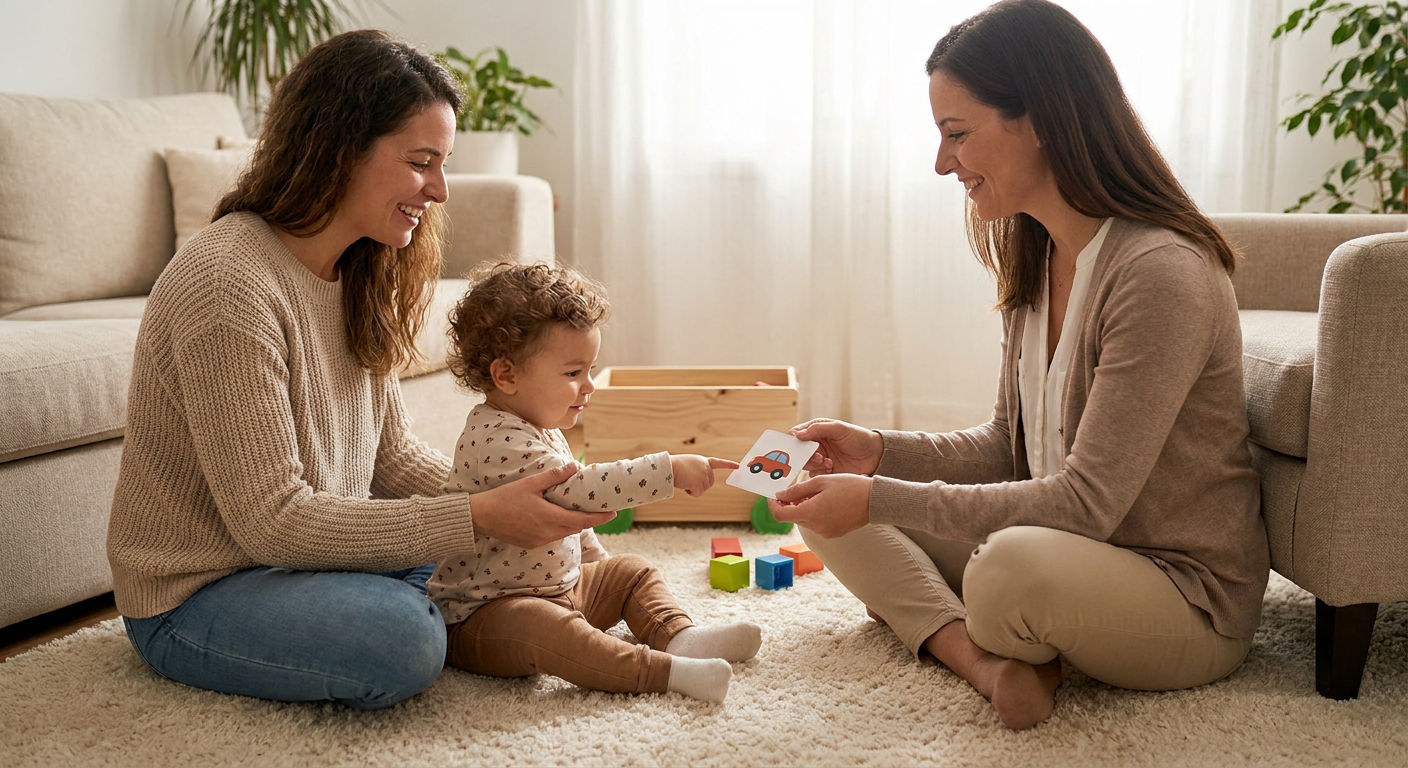
If your toddler isn’t talking yet (or isn’t talking much), the question underneath that worry is often much bigger: Will my child be able to tell me what they need?
That fear is real. So is the exhaustion of repeated frustration, meltdowns, and moments when you know your child is trying to communicate but neither of you can quite get there.
This article can help you understand what early communication really looks like in toddlers, how to recognize the signals your child may already be sending, and what meaningful progress can look like before spoken words take off.
What Communication Actually Means for Toddlers
Communication and speech are not the same thing. Speech is one way to communicate, but toddlers can express wants, needs, refusals, and requests in many different ways before full words develop.
A toddler can communicate by:
- Reaching toward an object or person
- Pointing to something they want
- Signing “more” or “all done”
- Handing over a toy when they need help
- Turning away or pushing something back to say no
- Using a picture, gesture, or sound to get your attention
That matters because meaningful communication can begin and grow significantly before speech does. For some children, spoken language develops later. For others, a mix of gestures, signs, pictures, or simple approximations becomes highly effective. The goal is not to rush to the most typical-sounding response. It is to help your child reliably express what they need in a way you can understand.
Why Behavior Is Often Communication
Toddlers use behavior when communication feels too hard, too slow, or unsuccessful. That does not mean the behavior should be ignored. It often means there is a message worth looking for underneath it.
A child may be trying to say:
- Help me
- I want that
- I need a break
- Look at me
- No
- All done
- This is uncomfortable
In real life, that can show up during snack time, getting dressed, during cleanup, when a toy is taken away, or when a routine changes without warning. A toddler who throws a cup may be asking for more juice. A toddler who drops to the floor during a transition may be saying they need more time. A toddler who hits during dressing may be communicating discomfort, frustration, or refusal.
The goal is not to punish the child for having a need. It is to understand the need and help them find a communication response that works better.
Developmentally Appropriate Ways Toddlers Communicate
Before reliable speech, early communication often looks like this:
Gestures and body language
Reaching, pointing, showing, pushing away, or nodding are all communication. These emerge naturally and are often a child’s first reliable way to make themselves understood.
Vocalizations and approximations
Sounds, babble, and early word attempts count. A child who says “muh” consistently for milk is communicating, even if it doesn’t sound like a full word yet.
Signs
Simple signs like “more,” “eat,” “help,” or “all done” give toddlers a clear, low-effort way to express common needs before speech is ready.
Objects and pictures
Handing you a cup to ask for a drink, pointing to a photo of the park, or reaching toward a snack container are all meaningful communication acts.
AAC (augmentative and alternative communication)
For some toddlers, a simple AAC device or picture-based system gives them access to language and expression earlier than speech would allow.
All of these are valid, developmentally appropriate ways of communicating. None of them are a step backward from speech. Many children use them alongside developing speech, and some use them as their primary form of communication long-term.
How to Support Early Communication at Home
Follow your child’s lead
Notice what your child is already attempting: pointing, reaching, making sounds, and respond to it. When communication attempts get a response, children learn that communication works.
Match the target to what they can do now
The best first communication target is quick, low effort, and easy to repeat. If speaking is harder than crying or grabbing, speech is not the right first response to require in the moment.
Respond clearly and consistently
Children keep using communication that works. When your toddler signs “help,” reaches toward a picture, or uses a sound to make a request, responding quickly and meaningfully teaches them that communication is powerful.
Build it into daily routines
Communication is easier to learn in the moments where the need naturally happens. Snack time, cleanup, dressing, transitions, and play offer natural opportunities to practice requesting help, asking for more, or saying all done.
Use simple language yourself
Narrating what’s happening (“You want more.” “All done.” “That’s hard — want help?”) helps toddlers connect words and meaning, even before they use those words themselves.
Everyday Examples of Early Toddler Communication
Asking for help: Your toddler throws a toy after struggling to use it. Instead of escalating, they learn to hand it to you or reach up. You help right away and name it simply: “Help. I’ve got it.”
Asking for a break: Your toddler drops to the floor during cleanup. A simple signal – a gesture toward a quiet space, a break card, or a single AAC button – teaches them to ask for a pause rather than shut down. You honor the request when it’s safe and appropriate.
Requesting something they want: Your toddler grabs and cries for a snack. A first signal might be pointing to the snack, signing “eat,” or using a simple approximation. You provide it promptly after the attempt, reinforcing that communication gets results.
Saying no or refusing: Your toddler swats at clothing during dressing. A safe refusal signal, example: pushing a choice away, signing “no,” or indicating “all done” – is a real communication skill. You pause, acknowledge it, and decide what adjustment is needed.
Getting your attention: Your toddler hits your arm when you’re talking with someone else. A first signal might be a tap on your hand, saying “mom,” or using an attention card. You turn briefly and show that the new signal works.
In each of these, the goal is not perfect behavior. It is clearer understanding, lower stress, and more successful communication.
What Progress Looks Like Before Speech
It can feel like all progress depends on whether your child starts talking. But communication growth is often visible before verbal speech changes in a big way.
Progress may look like:
- Your child asking for help instead of escalating
- Transitions becoming smoother because they can signal what they need
- Caregivers spending less time guessing
- Shorter frustration cycles
- More consistent communication attempts across different routines
These are meaningful signs that your child is gaining communication power, even if speech is still limited.
When to Seek Additional Support
Parents can do a lot to support early communication at home. But you do not have to guess through every difficult pattern alone.
Consider reaching out to a speech-language pathologist (SLP) or a behavior specialist if:
- Communication attempts feel very unclear or inconsistent
- Frustration and challenging behavior are escalating frequently
- Progress feels stalled despite consistent effort
- You are unsure which communication targets to prioritize
A structured approach (sometimes called functional communication training) can be helpful when behavior seems to be standing in for communication. This approach focuses on identifying what a child is trying to express through difficult behavior and teaching a clearer, easier way to say it. It works best alongside support from an SLP and, when relevant, a BCBA.
The best support is not about chasing quick fixes. It is about choosing communication targets thoughtfully, respecting your child’s pace, and building routines that make communication feel safe and successful. Possibilities ABA approaches this work through a relationship-first lens, grounded in connection, collaboration, and trust — values you can explore further across the Possibilities ABA site.
Supporting Early Communication
What might my child be communicating?
- What happened right before the behavior?
- Are they trying to get something, stop something, or get my attention?
- Does the pattern suggest help, a break, a request, a refusal, or comfort?
What communication signal can we try first?
- Is it realistic for this moment: a gesture, sign, picture, or sound?
- Can they use it quickly enough before frustration rises?
How are we responding?
- Are we responding clearly and quickly to new communication attempts?
- Are we making the new signal feel more successful than the old pattern?
What progress are we watching for?
- More frequent communication attempts?
- Shorter frustration cycles?
- Smoother routines with less guessing?
FAQ
Can my toddler communicate meaningfully before they speak?
Yes. Toddlers can communicate through gestures, signs, pictures, sounds, and AAC before spoken words develop. These are all real, valid forms of communication — not substitutes to outgrow, but building blocks that support language development.
What is developmentally appropriate communication for a toddler?
Before age two, most toddlers communicate through a mix of gestures, pointing, vocalizations, and emerging words. The range is wide. What matters is that your child is attempting to communicate and that those attempts are being understood and responded to.
What is the difference between speech and communication?
Speech is one way to communicate. Communication is the broader ability to express wants, needs, refusals, and requests in a way others understand. A child can make real communication progress before speech changes significantly.
How can I tell if my toddler’s behavior is really communication?
Look at what happens right before and right after. If a behavior reliably stops when a need is met, or if it happens in predictable situations, it is often communicative. Ask: what is my child trying to get, avoid, or change in this moment?
When should I talk to a professional about my toddler’s communication?
If your child is not pointing or using gestures by 12 months, not using any words by 16 months, or losing skills they previously had, talk to your pediatrician. An SLP can help assess development and recommend next steps. Earlier support is almost always better.